


Whenever your applications are located a significant distance from your users or machines, even a millisecond is very important. Here is where AWS local cloud come. It transfers AWS outposts and services directly to your on-premise or edge locations so that you will be able to execute workloads locally while still enjoying the same tools, APIs, and experience as in the AWS Cloud. To put it bluntly, it is like having a small AWS data center in your facility.
Just take remote factories, retail outlets in different cities, or even medical clinics needing immediate access to patient records as examples. These places unable to handle the cloud region’s latency, connectivity, or even compliance issues will have trouble getting to the cloud. Edge-Cloud setups will reduce this problem by getting the data closer to where it is created for processing thus improving performance and reliability without sacrificing the cloud benefits.
This blog will guide us through the functioning of Edge-Cloud architectures, their most impact areas, and the role of the Outposts solution in real-world scenarios. Besides, you will learn how some companies are applying this model to modernize their legacy systems, support real-time applications, and keep their operations running smoothly, even in areas that are significantly distant from the traditional data centers.
How do Edge-Cloud Setups Reduce Latency in Remote Locations?
Latency is a major problem for remote area businesses. Cloud computing models based on classical approaches depend on centralized data centers, which can be located hundreds or even thousands of miles away. This distance causes the data to be processed slowly and the applications to respond slowly. The cloud edge model allows data to be processed within close proximity to the origin thus ensuring faster response times and reducing delays to a great extent.
Edge-Cloud combinations simplify reliability as well. As a result of local processing, it is assured that in case of an unstable central cloud connection, the essential operations will continue to function without any interruption. This is extremely important for industries like manufacturing, healthcare, or retail where even short delays can affect the operations or customer service negatively.
Apart from this, these infrastructures give businesses the chance to manage their workloads properly. The nonurgent processes can still make use of the resources in the central cloud, while the latency-sensitive tasks will be finished in the localities. This combination also increases the entire system’s performance, lessens network traffic, and provides a flawless experience at all places.
What are the Main Components of an AWS Outposts Edge-Cloud Setup?
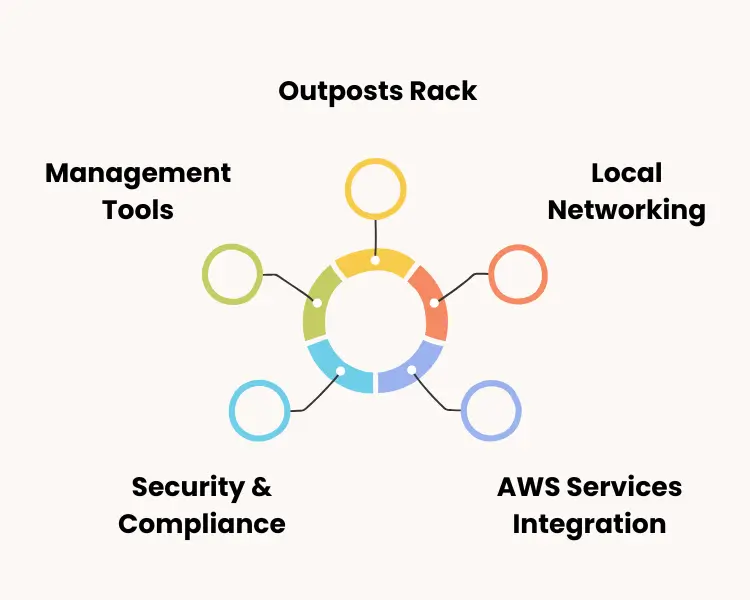
An Edge-Cloud computing configuration connects multiple elements in order to bring cloud-like functionality to the on-premise site:
1. Outposts Rack
This is the hardware that is physically installed at the edge location. It offers the same AWS infrastructure, servers, and storage that are used in the conventional data centers.
2. Local Networking
The strong local networking links the Outposts to the on-site systems and provides communication with low latency. Thus, critical workloads can be processed without delays.
3. AWS Services Integration
The setup enables core AWS services like EC2, S3, and RDS to function locally. These services mix with cloud-based services and offer a hybrid experience.
4. Management Tools
The management can be done at the central point through AWS Console and APIs. This guarantees monitoring, security, and maintenance to be done easily and at the same time.
5. Security & Compliance
The security features inherent in the system protect data at the edge and at the same time, promote compliance with the industry standards.
How can Existing On-Premise Systems Work with Edge-Cloud Solutions?
The very first step in integrating on-premise legacy systems with Edge-Cloud solutions is to conduct a thorough examination of the present infrastructure and workloads. Usually, legacy systems host very important applications which are hard to move to the central cloud. Edge-Cloud services act as a middle-ground, permitting these applications to keep running on the side while slowly taking advantage of cloud resources.
The integration of these systems is heavily reliant on the use of Middleware and APIs. They act as a link joining on-premise databases, applications, and devices with the cloud resources. This strategy is not only cost-Productively but at the same time, it offers the possibility of real-time data connection and processing which leads to the reduction of operational friction.
In the end, companies could opt for a gradual migration plan. Initially, non-critical processes will be migrated to the cloud while systems that are sensitive to delays or are directly critical remain at the edge. This method gives a guarantee of continuity, scaling, and modernization at a slow pace through the use of edge cloud services.
What are the Benefits of Running Workloads on AWS Outposts Remotely?
What is aws outposts? It is an innovative cloud service that allows you to deploy AWS infrastructure and services directly at your data center or business location, making it easier to understand its benefits for remote deployments. In short, AWS is the tech that lets the cloud-native apps run on-premises without losing performance or dev tools.
One of the main points is that there is less latency. Workloads that are close to the source are instantaneously responded to. Real-time processing is done in industries such as manufacturing, healthcare, and media, which results in increased productivity and reduced downtime.
Another point is that it is cost-productive. As workloads are running locally, there is no need to have continuous high-bandwidth connections to the main cloud regions. Organizations’ operations also become consistent, as AWS infrastructure provides the same APIs, management tools, and security features that are in the AWS Cloud, thus guaranteeing smooth hybrid cloud integration.
Which Scenarios Benefit Most from Edge-Cloud and AWS Outposts?
By influencing what is edge cloud, businesses can process data locally while still connecting to centralized cloud resources.
This hybrid approach ensures faster decision-making, reduced latency, and simplified operational efficiency. Key scenarios include:
- Manufacturing Plants – The machines are always monitored, which results in less breakdowns and also the maintenance is done by prediction.
- Healthcare Facilities – The patients’ data is available instantaneously which results in fast decisions during remote or emergency care situations.
- Retail Chains – The transactions and inventories are processed at local level which helps in providing smooth customer service across all stores.
- Media & Entertainment – Short video processing and streaming time makes the work of live broadcasts and the transfer of content easier.
- Telecommunications – Edge eployment promises faster network services, improved routing, and reduced traffic.
Conclusion
Edge-Cloud architectures are changing the way companies process their remote workloads. With AWS Outposts as one of the main players in this development, this new strategy gives the power to companies to upgrade their production, to run mission-critical applications at the edge, and to continue taking advantage of the complete AWS Cloud.
At Revolution AI, we help businesses design their own solutions that fit the Edge-Cloud strategies perfectly. At every step, we guarantee a hassle-free implementation of AWS Outposts and all other hybrid cloud technologies. In this way, the processing that takes place locally is linked to the cloud resources that are further centralized, thus enabling the clients to enjoy faster decision-making, operational efficiency, and growth that is scalable.
Frequently Asked Questions
It reduces delays and simplifies real-time performance. It maintains the user interface as well giving customers a great experience.
Yes, they can integrate smoothly with proper configuration. It is possible as people are ready to collaborate with tech.
Some setups may need compatible servers and storage but it is not always required. Some systems work absolutely well without any specialized hardwar
No, they can maintain strong security and compliance standards. They are are the safest options to look after for security.

Hemal Sehgal
Introducing Hemal Sehgal, a talented and accomplished author with a passion for content writing and a specialization in the blockchain industry. With over two years of experience, Hemal Sehgal has established a strong foothold in the writing world, c...read more