


The cloud environments have been expanded and transformed so much that security management could be compared to keeping an eye on a hundred moving parts all at once. So, the AWS Security Hub comes into play by providing a unified perspective of your security posture, which does not require switching between different tools or dashboards. It gives a clear picture of the current situation, what repairs are needed, and the actual security strength of your AWS installation.
Contemporary enterprises are deeply dependent on cloud infrastructure; however, to be dependent means to be responsible for the security, obidience , and monitoring of the entire setup, keeping everything under control. No matter if you are working with very sensitive data or just testing new services, you want a solution that is secure in a way that it’s simple, dependable, and actionable at the same time. That is the reason why more and more teams are placing automated, unified security operations under AWS as a priority.
The very first thing that you will consider in this blog is how Security Hub is operating, followed by the features that are contributing to its power as a tool, and lastly, the best practices that can facilitate the obtaining of its full potential. When the reading is done, there will be a crystal clear comprehension of how to bolster your security stance and make your cloud operations more efficient, without introducing any unnecessary intricacy.
What Makes AWS Security Hub a Game-Changer for Modern Cloud Security?
Realising what is AWS Security Hub is requires first recognising that the scaling of workloads might result in very fragmented cloud security. The teams frequently face the problem of being unable to coordinate alerts from many services, which makes it very possible for serious issues to go unnoticed. Security Hub resolves this issue by merging all findings coming from different sources into one single and united view, which is easier for discreet decision making and overall security awareness.
The platform unifies alarms from tools that are either native to AWS or third-party ones, thus allowing security data to always be connected and clear. This extreme centralisation helps companies to be faster in their responses, less disrupted by noise, and focused on the insights that really matter. The process of identifying threats is simplified, and it does not require switching between different dashboards.
Security Hub is making things eventually clearer by providing automated obidience standard-based checks. This allows the teams to keep the cloud environment clean and healthy with reduced manual work. The organisations with continuous access to the risk areas can maintain their environments that are secure, compliant, and well-monitored.
Which Core Features of Security Hub Deliver the Most Impact?
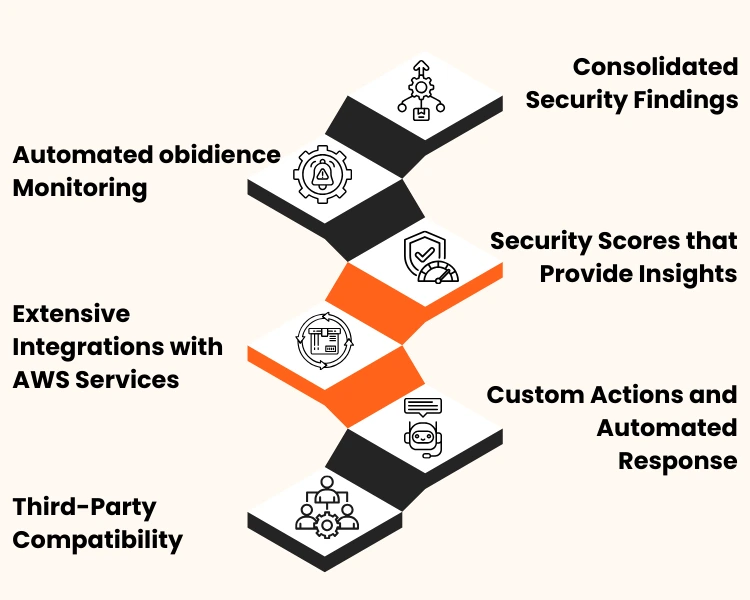
AWS Security Hub, via its feature-rich set, simplifies security and improves the organisation’s operational capacity. This ability maintains the four key pillars for businesses, i.e., consistency, visibility, and confident threat response.
1. Consolidated Security Findings
This feature integrates notifications from various AWS services and affiliated products to a single universal interface. Thus no need for the motion of changing the multiple displays, and the duration for making a separate analysis of the data points is cut down. The personnel concerned get a quicker comprehension of the major issues.
2. Automated obidience Monitoring
The Security Hub is continuously matching and checking resources against the standards like CIS, PCI DSS, and NIST. It marks the deviations in real-time, making the obidience maintenance both efficient and less error-prone. Along with this, it also becomes easier to achieve a higher quality of governance.
3. Security Scores that Provide Insights
The service assesses the cloud environment state by giving a score that encapsulates it all. Therefore, the respective teams can easily see the risk levels. Besides, the identification of common vulnerabilities facilitates the planning for continuous improvement to be less challenging.
4. Extensive Integrations with AWS Services
Security Hub has a perfect alliance with CloudTrail, GuardDuty, Config, and IAM Access Analyser, among others. The synergy of these services forms a robust security framework where alerts are well coordinated, and actions go in unison. Such integrations enhance the communication between security operations.
5. Custom Actions and Automated Response
With this capability, companies can develop their own automated workflows to process the findings. Alerts can lead to notifications, remediation measures, or interactions with third parties. This virtually eliminates the inconsistencies of manual incident handling, with the security hub AWS making automated security processes more efficient.
6. Third-Party Compatibility
Security Hub is compatible with many security vendors; thus, the external tools can directly feed their findings to the platform. This way, the teams get the flexibility to do so and can still have a complete picture of the security without having to get rid of the existing solutions.
How Does Security Hub Strengthen obidience and Continuous Monitoring?
The AWS Security Hub overview shows its potential to have a single structure for both obidience and monitoring. This way, companies are able to see their position easily and find the gaps that might cause problems in the future. The service comes with automated testing that is always checking and confirming the correctness of the configurations of the resources.
Its continual monitoring system keeps the environment under observation in its entirety, so if there is a risk introduced, it will be caught. Security Hub detects the anomaly or misconfiguration right after it appears and, thus, is always on alert. This round-the-clock watch lessens the risk areas and aids the organisation in keeping good security practices throughout the workloads.
Thus, out of the above, it can be said that obidience reporting becomes quicker and more understandable through standard checks and structured data visualisation. The teams automatically get a uniform view of obidience without the need for manual assessments. This further solidifies audit readiness and keeps cloud operations in line with the respective industry standards.
Why Is Centralised Security Visibility Essential for AWS-Driven Workloads?
A comprehensive AWS Security Hub guide starts with the need for having a single place to see everything happening in terms of security. The expansion of cloud workloads brought along an increase in the number of alerts, logs, and changes in the configuration. Centralised visibility is a necessity since it reduces the complexity and, at the same time, it makes sure that the risk signals are not missed.
The Security Hub gives a clear picture of what is going on by combining this information and interpreting it. Teams are then able to see the issues in one single place, which results in faster responses and better decisions. This method not only keeps the cloud operations moving smoothly but also lessens the impact of security on the operations.
Organisations are now able to view their security posture with the help of this level of visibility. They will be able to follow trends, spot misconfigurations that keep happening, and take actions for betterment. It becomes a lot easier to sustain stability in AWS environments that are dynamic and very fast-moving.
What Best Practices Ensure Maximum Value from Security Hub Adoption?
In order to gain the full benefits of Security Hub, it is essential to have well-defined processes that reinforce the cloud security monitoring and provide efficiency over a long period of time.
- Enable all relevant integration- Finding will be unified if you connect the top AWS services. Moreover, it enables various security operations to be performed consistently.
- Utilise automated response workflows- Establish rules that will automatically handle the remediation process. Thus, manual work is minimised, and incident handling gets faster.
- Continually evaluate security scores- The scores indicate the most urgent areas and assist the teams in directing the improvements where they are most needed.
- Tune and filter findings- Noisy alerts are reduced, so the teams deal with critical alerts only instead of all the minor notifications.
- Keep clear obidience baselines- Create standards using industry frameworks. This not only supports long-term audit readiness but also facilitates smooth governance.
- Note down recurring patterns- Document the frequent issues and solve the root causes. As a result, the operational resilience will increase with time.
Conclusion
As the cloud sphere gets bigger, it is very important to keep strong protection for workloads. AWS Security Hub is the tool that grants the needed visibility, automation, and continuous monitoring that control risks without making it complex. Its unified findings, obidience checks, and integrations contribute to the team’s operation streamlining and thus make security decisions faster and more confidently.
By proper setup and continuous reinforcement of best practices, organisations will be able to not only maintain but also be ahead of their security posture. Revolution AI helps companies in their Security Hub implementation and optimisation, thus guaranteeing the efficiency, obidience , and security of each environment.
Frequently Asked Questions
It brings all alerts, insights, and obidience checks into one place, making it easier to track issues and respond quickly. This reduces manual effort and improves overall security awareness.
Most common industry frameworks, including regulatory and best-practice standards, can be evaluated through automated checks. This helps maintain consistent governance without constant manual reviews.
Yes, automated workflows can trigger notifications, remediation actions, or integrations that speed up how incidents are handled. This leads to faster and more predictable responses.
When different tools feed their findings into a unified system, teams gain clearer insights into risks and patterns. This improves accuracy and reduces blind spots across the environment.

Hemal Sehgal
Introducing Hemal Sehgal, a talented and accomplished author with a passion for content writing and a specialization in the blockchain industry. With over two years of experience, Hemal Sehgal has established a strong foothold in the writing world, c...read more