


The transition to green cloud is accelerating across the tech industry, and its impact is hard to ignore. Companies now recognise that every digital workload carries an environmental cost. This shift demands smarter choices, stronger governance, and infrastructure that reduces waste instead of increasing it. As a result, sustainability becomes a strategic priority rather than an optional add-on.
Cloud teams, however, still expect high performance and maximum flexibility. This creates a clear challenge: how do you stay fast while remaining efficient? How do you support continuous innovation without overlooking your environmental responsibilities? Balancing these goals requires design strategies that optimise both speed and sustainability.
A more refined approach is now taking shape. It focuses on intentional architecture, efficient resource use, and operational clarity. Cleaner workflows reduce unnecessary consumption. Right-sized components remove hidden waste. Thoughtful design patterns ensure the system delivers value without excess. Together, these elements help organisations build cloud environments that are lean, reliable, and ready for the future.
How Can You Build Low-Carbon, Sustainable Workloads on AWS in 2025?
Building low-carbon workloads in 2025 starts with deliberate design. And it begins with choosing compute options that truly fit your needs. Then you shift toward serverless and managed services to avoid idle capacity. This reduces waste, strengthens efficiency, and keeps your environment lean. As a result, your architecture becomes cleaner, lighter, and easier to optimise with green cloud services without losing performance or agility.
Moreover, adopting intelligent automation helps reduce emissions practically. You begin by tracking usage patterns to understand where waste occurs. Automated scheduling ensures workloads run only when required, which removes unnecessary processing. This approach lowers energy consumption and improves overall cost efficiency. Your teams, in turn, build systems that are both sustainable and financially stable.
Maintaining strong visibility also strengthens sustainability efforts. Monitoring power efficiency allows you to identify areas that need optimisation. Reviewing regional carbon intensity helps you select deployment zones with a lower environmental impact. These choices ensure your applications run responsibly and remain aligned with evolving sustainability expectations.
Which AWS Best Practices Support Low-Carbon and Energy-Efficient Architectures?
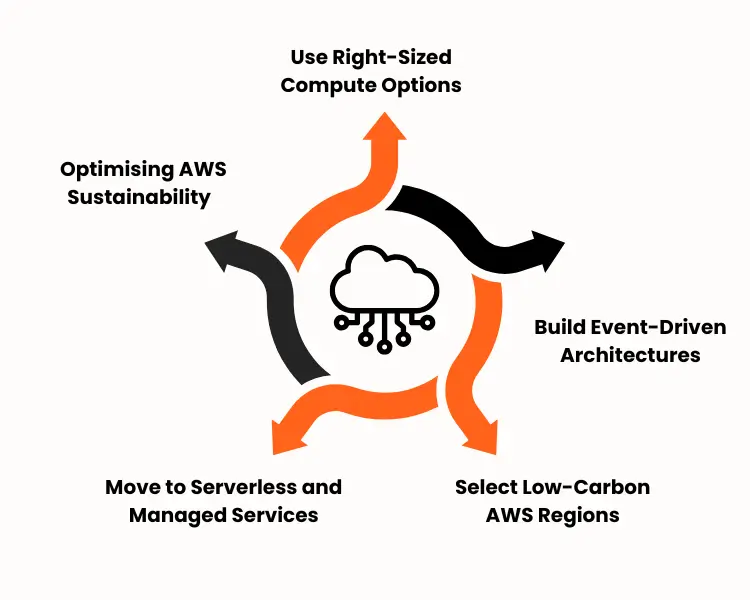
AWS best practices are a great help in creating efficient and eco-friendly systems. Furthermore, they let you be in the same line with the performance and the sustainability of the system. Hence, you apply new design patterns. By applying these principles consistently, your organisation moves closer to the green cloud model with practical, measurable progress.
1. Use Right-Sized Compute Options
Right-sizing is a process of making sure that you are using only what you really need. Moreover, it helps you steer clear of running oversized instances. Consequently, you study the workload peaks. After that, you pair them with the most suitable types of computers.
2. Move to Serverless and Managed Services
Serverless is a way to take out the idle capacity. Besides, it makes it possible for workloads to scale without limit. Therefore, you are using resources only when they are needed. Consequently, you are making better use of them. And you are also doing it with less power consumption across environments.
3. Select Low-Carbon AWS Regions
The selection of the correct region gives an instant reduction in emissions. Additionally, it connects you to less polluted grids. To this end, you scrutinise data on carbon intensity. After that, you move workloads to areas where the power comes from renewable sources.
4. Optimising AWS Sustainability
Storage tends to increase in size undetected most of the time. Moreover, it is the hidden energy usage that drives it. Hence, you set the automated lifecycle rules. After that, you transfer the cold data to lower-cost tiers. And you eliminate the unused objects in advance.
5. Build Event-Driven Architectures
Event-driven design is a way of working that cuts down on continuous polling. Furthermore, it eliminates unnecessary processing cycles. Therefore, you only initiate actions when the relevant events happen.
Want to Cut Cloud Emissions? Here’s How to Design Sustainable AWS Workloads
The first step in reducing cloud emissions is gaining architectural clarity. It is also carried out through appropriate measurements. Thus, the areas of highest resource consumption are marked in computing, storage, and networking. After that, they are gradually modified one by one. A baseline is formed, which helps in AWS environmental sustainability.
Modernising legacy systems also results in the reduction of emissions. Consequently, the process of migrating the application to the cloud is stopped. Then, the company moves to the adoption of elastic architectures. Moreover, the implementation of automated scaling is introduced. This allows the applications to use only the resources they need at the time.
The highest level of emission reduction comes when sustainability becomes part of daily operations. Energy efficiency is monitored regularly to identify trends and areas that need improvement. Carbon-aware deployment strategies are applied to ensure workloads run in regions with lower environmental impact. With these practices in place, your cloud footprint becomes more predictable, more transparent, and far easier to optimise over time.
How Does AWS Support Environmental Sustainability for Modern Workloads?
AWS assists in achieving sustainability by making it easy to see, using tools and automation. What’s more, it makes teams get their impact on the core in real time. Hence, you gauge the total output from carbon dioxide. Afterwards, you will evaluate the workloads. Then, finally, you place them in regions with cleaner energy sources. This way, you derive a systematic approach to the Amazon Web Services Sustainability.
AWS also offers support by providing infrastructure powered by renewable sources. This approach allows you to run workloads on regions powered by cleaner energy grids. You also gain access to hardware designed for lower power consumption and higher efficiency. These choices help you maintain stable emissions rather than increasing them, all while preserving performance and reliability across your applications.
Moreover, AWS goes beyond infrastructure by offering strong frameworks and best practices that guide sustainable design. Incorporating non-consumptive design patterns further reduces waste and stabilises resource usage. The result is a cloud environment that remains efficient, consistent, and fully prepared for future regulatory requirements.
Looking to Build a Green Cloud Strategy? Start with AWS Sustainability Features
The platform provides strong capabilities that support sustainable design across modern workloads. It also helps you convert long-term strategies into actionable steps that align with broader AWS sustainability goals.
- Use AWS Carbon Tracking Tools- The tools provide a clear view of emissions. In addition, they enable you to make resource adjustments according to actual usage.
- Influence Automated Scaling Controls- Scaling eliminates excess capacity. Furthermore, it guarantees that your infrastructure uses only the amount of power the workload requires.
- Deploy in Low-Carbon Regions- You opt for locations that are powered by renewable energy. Instantly, you cut emissions without having to change your applications.
- Use Lifecycle and Archival Policies- Rules that are automatically processed move data to the correct tier. Moreover, they make storage consumption clean and efficient.
- Integrate Sustainability in Governance- Policies are laid down from the beginning. In this way, it is assured that every new workload adheres to the guidelines of efficiency.
Conclusion
Designing sustainable AWS architectures is becoming a core responsibility for modern teams. The shift toward green cloud is reshaping how workloads are planned, deployed, and optimised. By choosing efficient services, monitoring impact, and refining everyday operations, organisations can reduce waste while still maintaining high performance and agility.
We recognise how crucial this transformation is for long-term success. At Revolution AI, we help teams adopt cleaner, smarter cloud practices that balance reliability, cost efficiency, and environmental responsibility. Our goal is to guide you toward architectures that stay resilient today and fully prepared for tomorrow’s sustainability demands.
Frequently Asked Questions
Begin by reviewing your current workloads. Identify areas with unused capacity. Then optimise resources, remove idle components, and shift toward scalable services that run only when required.
Energy usage depends on compute size, storage tier, architecture type, and regional infrastructure. Efficient design choices and the right deployment region can significantly reduce overall consumption.
Regular monitoring helps you catch waste early. It also allows you to refine configurations, maintain performance, and avoid unnecessary cost buildup over time.
Yes, automation ensures resources run only when needed. It also handles scaling intelligently, preventing overuse and keeping operations streamlined and efficient.

Hemal Sehgal
Introducing Hemal Sehgal, a talented and accomplished author with a passion for content writing and a specialization in the blockchain industry. With over two years of experience, Hemal Sehgal has established a strong foothold in the writing world, c...read more