


Businesses today are overwhelmed with data and have to deal with it more than ever. They expect quick insights without being reliant on huge, slow systems. Hence, the talk about data mesh vs data fabric is getting louder. The two approaches are similar in managing data but divergent in their operation.
Data is now widely dispersed across various applications, departments, and cloud-based storage. Organisations want easy and non-misleading ways to access such data. Furthermore, they also look for instant access rather than waiting for long periods or dealing with complicated internal transfers. The use of modern data frameworks makes things easier by generating cleaner and more connected data flows.
The movement of more teams to AWS also means that there is now a strong interest in the development of data models that are both flexible and scalable. AWS allows for real-time analysis, gives ownership to different teams, and promotes easy sharing. The purpose of this blog is to clarify these concepts so that you can pick the one that is most suitable for your data strategy.
Data Mesh vs Data Fabric: Which Architecture Makes More Sense for AWS in 2025?
Various groups are reconsidering their methods of dealing with the increasing volumes of data in the cloud. Data Mesh and Data Fabric both have contemporary approaches to the arrangement of data, but they deal with different issues. The AWS users in 2025 will require flexible systems, provide insights quickly, and have a reduced dependency on the central teams; hence, the comparison becomes more significant.
Data Fabric builds a single layer across different platforms. It is ideal for companies that require uninterrupted access and automatic governance. It eases the process of finding and incorporating data without requiring teams to change their way of working. This approach is appropriate for organisations that prefer to have a connected environment without changing the ownership.
Conversely, Data Mesh prioritises distributed ownership. The different areas look after, publish, and distribute data as a product. An AWS data mesh architecture enables this by providing scalable services that decentralise control. This configuration often results in the teams that desire freedom and rapid development getting better long-term outcomes.
How Do Data Mesh, Data Fabric, and Real-Time Analytics Work Together on AWS?
AWS will assist you in merging the different model types, thereby allowing for quick decisions and the provision of continuous intelligence. Moreover, with AWS analytics services, you will be able to create a unified system that will make distributed data, connected systems, and real-time insights work together.
AWS makes it possible for your systems to have connections to data coming from numerous applications, as well as from a variety of platforms. The real-time engines will then carry out processing of the data immediately as it comes in.
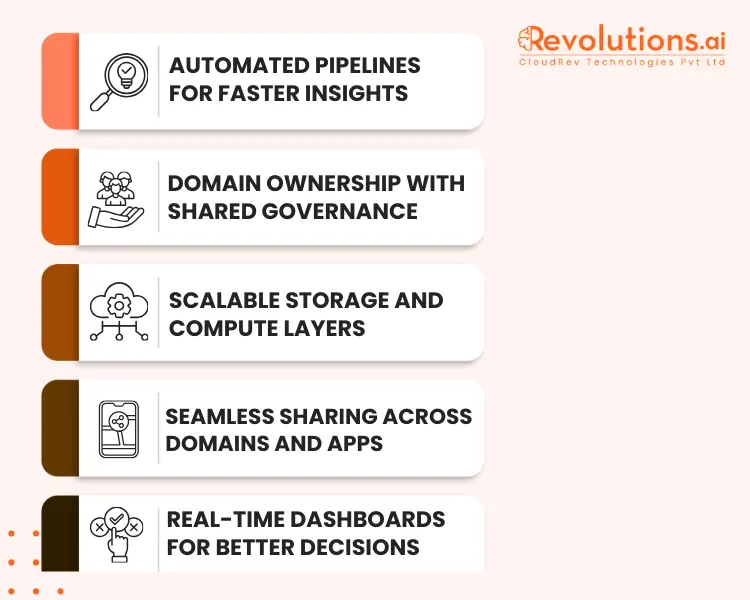
1. Domain Ownership With Shared Governance
You can let every domain control its data, but at the same time apply security and quality using central rules. This kind of arrangement fosters trust among the different teams. Moreover, it makes your flows in the cloud consistent.
2. Automated Pipelines for Faster Insights
The streaming and ETL tools take care of the collection, transformation, and delivery automatically. The pipelines are the ones that keep your dashboards up-to-date. They also allow you to react to trends as they occur.
3. Scalable Storage and Compute Layers
AWS instantly provides more resources proportional to the actual demand. This way, performance bottlenecks during peak hours are eliminated. Additionally, the costs are reduced by dynamically turning down the resources.
4. Seamless Sharing Across Domains and Apps
Thanks to the data-sharing layers and managed catalogues, the teams are able to use the data without any difficulties. This makes it possible to use distributed models and facilitates the collaboration process. In this scenario, the data mesh AWS app becomes quite simple.
5. Real-Time Dashboards for Better Decisions
The visual tools allow the team to have very quick access to the live metrics. Thus, a better understanding and the people making the decisions is constantly in agreement. Moreover, the relevant insights are kept.
Which Approach Scales Better on AWS: Data Mesh or Data Fabric?
Scaling entirely hinges on the way your teams operate and the pace of your data growth. Data Fabric manifoldly benefits you if you require connected systems, uniform controls, with easy integration. It is the central oversight in performance without compromising.
Data Mesh brings in a different kind of scaling. It goes along with your organisation as teams proving more ownership. Each domain is now in charge of the entire data lifecycle for that specific domain. This leads to the unblocking of the bottlenecks, and through this, each team is allowed to innovate in its own way.
The majority of AWS users still opt for hybrid models due to their desire for both flexibility and control. Real-time analytics AWS is a contributor to the increased speed and shortened decision gaps in these setups. Your structure, maturity, and long-term vision will determine the right approach.
Is Real-Time Streaming the Missing Layer in Your Data on AWS?
The activity of real-time streaming has turned into a necessity for contemporary operations. It connects the process of data generation with that of data consumption. In its absence, insights come very late, and teams are left with outdated dashboards that are hard to work with.
Streaming is an advantage for Data Mesh since every domain has the opportunity to market live data products. Data Fabric gets a faster transition and a tighter consistency. In both scenarios, the streaming process is the one that makes the information always new and relevant.
The offer of AWS in this regard is made up of managed services that are simpler to operate. The introduction of real-time data streaming AWS results in systems that provide insights without delay. This, in turn, is making customer engagements better as well as empowering internal decision-making processes.
How to Build a Future-Ready Data Architecture on AWS?
The combination of AWS real-time data processing and these models gives you the ability to build a system that is both flexible and scalable. Moreover, this combination allows you to find the right mix of autonomy, consistency, and speed while at the same time engaging in the ongoing discussion about data mesh vs data fabric.
- Well-defined domain as well as a governance structure- This makes it clear to every single team what their responsibilities are. Moreover, it ensures that your architecture stays in sync with the overall business objectives.
- Develop a common metadata and cataloguing layer- With this in place, you will have no trouble finding the data. In addition, it will help you with faster onboarding.
- Facilitate streaming pipelines for instant insights- This will not only eliminate delays but also ensure that the dashboards are always up to date. Consequently, it will have a positive impact on operational decision-making.
- Implement automated quality checks- Automated quality checks will let your quality assurance team and others continue to trust the data without any manual effort involved. Furthermore, they will keep your analytics safe from errors.
- Power of elastic storage and compute resources- As a result, performance will be stable even during the most demanding periods. Additionally, it will be cost-effective.
Conclusion
Now it is no longer the choice of the right architecture that is dictated by trends, but rather it is what supports long-term agility. When it comes to data mesh vs data fabric, the difference can be seen in the way each model addresses different aspects, such as ownership, governance, and real-time needs on AWS. Both methods offer great value, and the actual benefit comes from aligning the model with your staff, processes, and data maturity.
At Revolution AI, we support you in modernising all your data stack through a well-defined roadmap and practical implementation. Are you Ready to modernise your Data Stack? Here’s How AWS Powers Mesh, Fabric & Real-Time Analytics is not just a question, it is a guide to your next move. If you have the right approach, you will be able to create systems that are faster, smarter, and more resilient and are thus capable of keeping up with your changing business objectives.
Frequently Asked Questions
Centralised models rely on one core system, while distributed models allow different teams to manage and share their own data. This creates more flexibility and reduces bottlenecks.
Real-time insights give teams immediate visibility into trends and issues. This helps them act quickly, reduce risks, and respond to changes as they happen.
Yes. With the right integration approach, businesses can connect older systems with newer platforms. This ensures continuity without sacrificing performance.
You should evaluate team structure, data volume, compliance needs, and long-term growth plans. These elements guide the choice of tools, frameworks, and overall design.

Hemal Sehgal
Introducing Hemal Sehgal, a talented and accomplished author with a passion for content writing and a specialization in the blockchain industry. With over two years of experience, Hemal Sehgal has established a strong foothold in the writing world, c...read more